Category Archives: Residential Moving

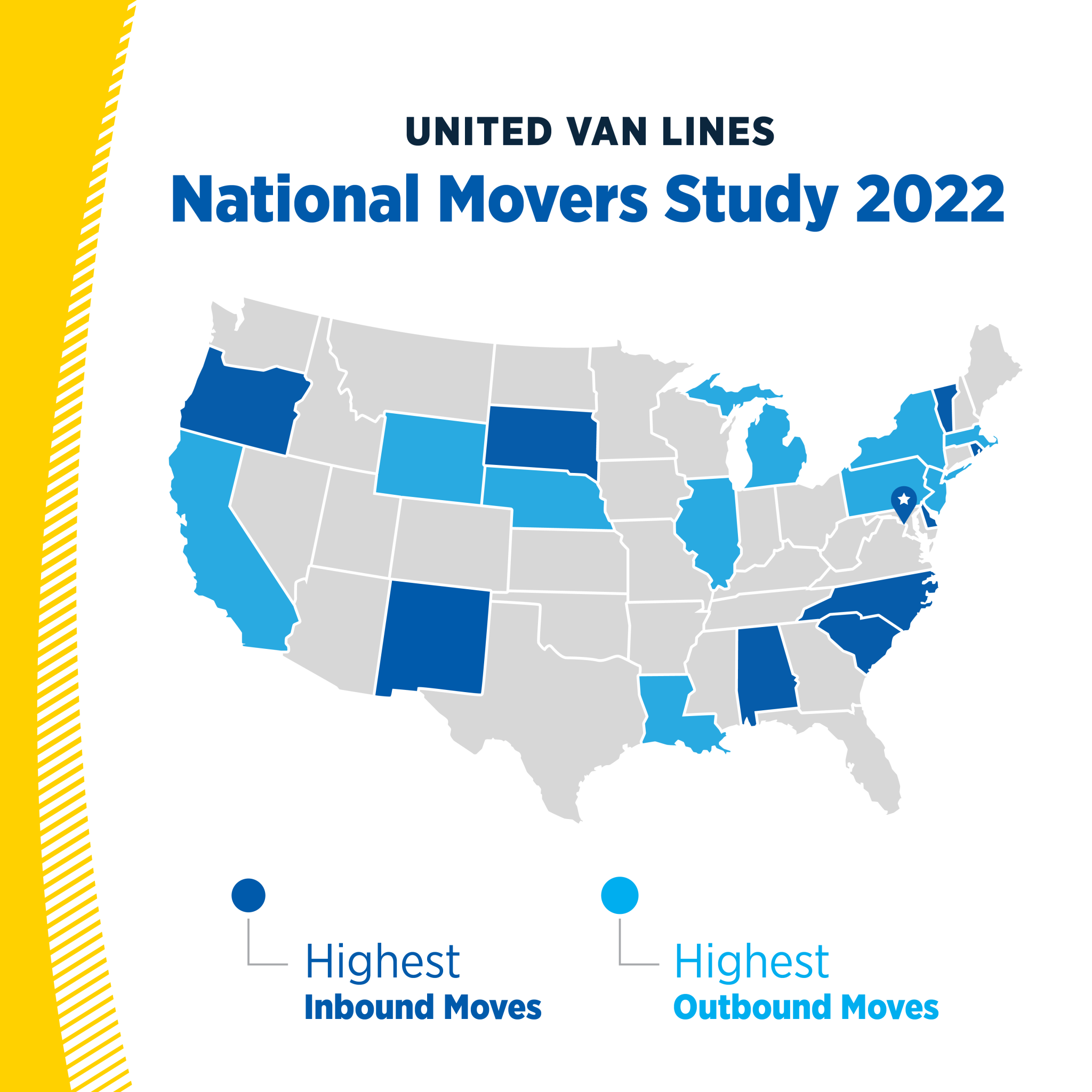
This year’s United Van Lines National Movers Study released early last week provides a fascinating insight into American migration patterns. According to the study, Baby Boomers and Gen Xers drove the shifts in migration, with Eastern states seeing the highest inbound moves. Vermont topped the list of inbound states for the second year in a row, with an inbound percentage of 77%.

On the other hand, New Jersey was the top outbound state for the fifth consecutive year, with 67% of moves being outbound. The survey also revealed that Baby Boomers and Gen Xers accounted for more than 55% of all inbound moves in 2022, indicating that these generations are seeking out lower-density areas for lifestyle changes, retirement and to be closer to family.

In the Northeastern region of the U.S., Rhode Island (66%), Delaware (61%) and Washington, D.C. (59%) were popular moving destinations in 2022. Southeastern states such as South Carolina (61%), North Carolina (61%), and Alabama (58%) also saw a high percentage of moves. Oregon followed Vermont as a top inbound state for 2022, with an inbound percentage of 67%.

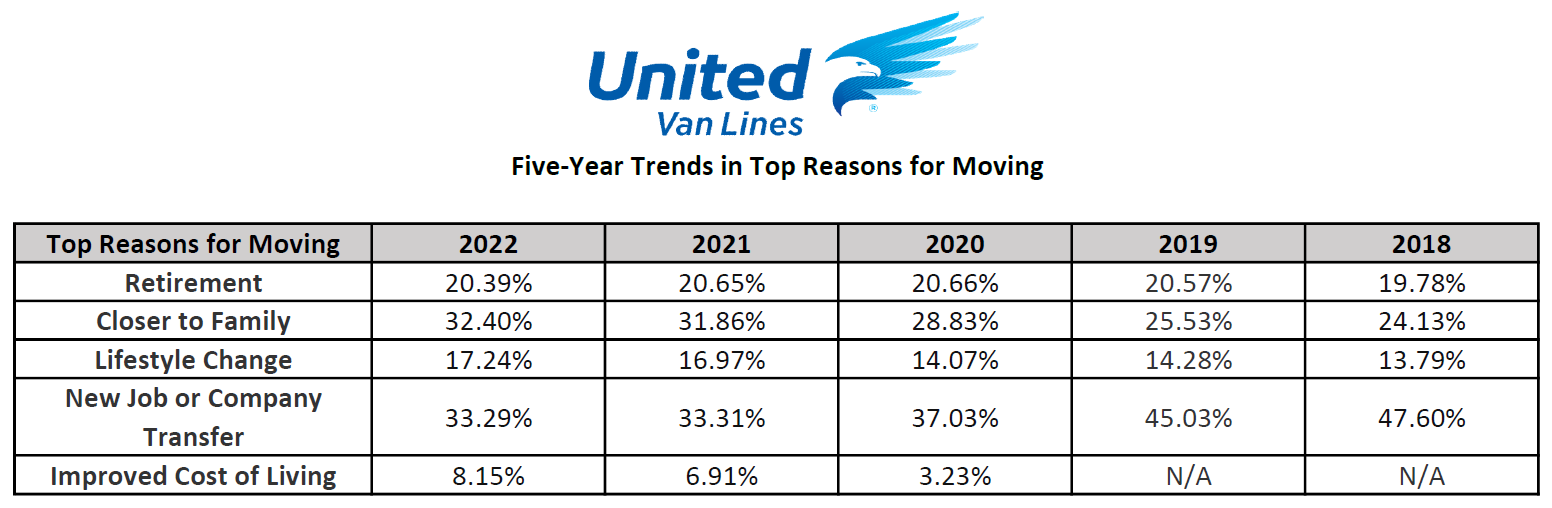
The study also highlighted the key factors driving migration patterns in 2022, such as new jobs or company transfers and moving closer to family.

five year trends in top reasons for moving

“Key factors like retirement, wanting to be closer to family and lifestyle changes influenced by the pandemic along with current housing prices drove moving patterns in 2022,” Michael A. Stoll, economist and professor in the Department of Public Policy at the University of California, Los Angeles, said. “The United Van Lines study encompasses data that Americans are now moving from bigger to smaller cities, mostly in the South, some in the West, but even an increase of migration to the Northeast, which has not been typical. We’re also seeing younger Millennials migrating to vibrant, metropolitan economies, like Washington, D.C. and Portland, Oregon.”

Moving In

The top inbound states of 2022 were:

  1. Vermont
  2. Oregon
  3. Rhode Island
  4. South Carolina
  5. Delaware
  6. North Carolina
  7. Washington, D.C.
  8. South Dakota
  9. New Mexico
  10. Alabama

Of the top ten inbound states, four — Vermont, Oregon, South Dakota, and New Mexico — are among the least densely populated states in America, with less than 100 people per square mile. South Dakota and New Mexico are among the top 10.

Moving Out

The top outbound states for 2022 were:

  1. New Jersey
  2. Illinois
  3. New York
  4. Michigan
  5. Wyoming
  6. Pennsylvania
  7. Massachusetts
  8. Nebraska
  9. Louisiana
  10. California

Balanced

Several states saw nearly the same number of residents moving inbound as outbound.

Missouri and Nevada are among these “balanced states.”

Where does this move data come from?

For more than 40 years, United Van Lines has been tracking migration patterns across the country. The 2022 study is based on the household moves made by the UniGroup network, which includes the 48 contiguous states and Washington, D.C. The states are classified as “high inbound” if over 55% of the moves are going into the state, “high outbound” if over 55% of the moves are leaving the state, or “balanced” if the difference between inbound and outbound is almost even.

How to use the interactive map below: Click on the image for additional details about each state’s move activity.

To understand inbound and outbound percentages for each state, use the legend. To view reasons for moving and demographic data, select the year and state that you would like to view using the dropdown menus. (If you are using a desktop computer, you can use your mouse to click and select a state.) Please note that percentages pertaining to demographic data may not always total 100% due to respondents having the ability to opt-out of answering survey questions and/or to select more than one survey response per question.

To view the entire 2022 study and additional information from United, please visit https://www.unitedvanlines.com/newsroom/movers-study-2022

How to Move Your Mattress

Mattresses are often one of the last items in your home that get loaded onto the moving truck. When it comes time to move to your new place, how do you prepare it for safe shipping? Some of our customers choose to do some or all of their own packing while preparing for move day.

This article offers tips for moving and packing the following mattress types:

Preparing Your Mattress for Moving

Mattresses are perhaps the most important thing in your home to pack. After a long day of moving in, you’ll need your mattresses set up in your new home to get a good night’s sleep. Special mattresses come with their own needs, and many require effort on your part in advance of the move, so it’s best to plan ahead before you move your mattress.

How to Move a Purple® (Hyper-Elastic Polymer) Mattress

The hyper-elastic polymer materials used in making most sizes of these beds are over 100 pounds. Be sure to use more than one person when lifting them.

Safety first! If your bed is going to be wrapped up for less than a day, the easiest, most economical way to move it is to:

  • Wrap it in plastic
  • Fold it in half
  • And tie it with non-stretchy straps (Purple recommends three or four nylon ratchet straps that also make great handles for lifting and carrying)

If your Purple® Mattress is going into storage or it will be in the moving process for more than a day, you’ll want to keep it flat and protected. They recommend using a plastic mattress storage bag then placing your mattress inside a mattress box and sealing it well with packing tape.

For more information about moving a Purple mattress, please visit the manufacturer’s website: https://purple.com/blog/move-purple-mattress

How to Move a Sleep Number Mattress

Similarly to an air mattress, Sleep Number beds must be deflated to prevent damage and boxed properly. The Sleep Number website recommends completely disassembling the base of your bed before moving, though the frame is very sturdy.

How to Move a Tempur-Pedic (or Other Memory Foam) Mattress

Did you know that if you store memory foam mattresses on their side for long periods of time, they can crack down the side? While the mattress can be folded temporarily to pivot around stairwells in your four-story walk-up, it’s not designed to weather these conditions through a long drive to Dallas or for months of storage in a portable container. Your memory foam mattress must be shipped flat.

How to Move a Traditional Mattress and a Box Spring

Storing and moving a mattress on its side is simple enough. However, consider the size of your mattress and whether or not it comes with a box spring. These are two separate pieces that your mover will have to account for.

Your mover or packing service will have these ready. Another option is to use a mattress carton, which might provide more protection during a long-distance move.

How to Move an Air Mattress

Simply deflate your air mattress to prepare it for storage. When rolling the mattress, roll it as tightly as possible to prevent any damage. Try to pack it in its original box, as it is guaranteed to fit.

How to Move a Waterbed

To put it simply, moving a waterbed means draining and folding it. But draining a waterbed isn’t all that simple; this process can be a little less complicated with several steps. First, remove your waterbed heater, this protects your mattress while draining it.

Next, decide on how to drain the mattress. An electric pump can be quick and efficient and are often rentable. You can also drain it au natural depending on the make. Refer to the instructions that came with your mattress or your provider for details that might be specific to your mattress.

As you are draining the water, tilt the mattress to get more water out. Roll the mattress like you would a rug. Move your mattress carefully after it’s drained to prevent ripping. If you’re storing the mattress get a conditioner to prevent mold and bacteria, otherwise it should be truck-ready.

How to Move a Futon Mattress

If possible, remove the cover of your futon mattress before moving. If you can’t remove the cover, find a mattress bag that fits the mattress to protect it from stains and damage. Disassemble your frame (keep track of all the parts!) and keep the mattress flat during the moving process, this keeps interior stuffing intact the way the crafters intended.

When you are moving, regardless of your location or how far it is, consult with your movers before putting your bed in the truck.

Tips for Packing Your Mattress

Gather the Right Mattress Packing Supplies

Packing your mattresses can be a little tricky and requires a lot of time and attention. Because they are so important, you want to make sure you do this properly.

In order to pack your mattresses, you’ll need the following supplies:

  • Permanent marker
  • Mattress cartons
  • Plastic bags
  • Moving pads
  • Roll of packing tape

How to Pack Mattresses Securely

As mentioned above, packing a mattress is not a simple task. What complicates it even further is that you’ll often have a mattress and a box spring, each of which has to be packed separately.

If you have more than one bed in your home, the efforts will just multiply. Even if you are just packing up one bed, though, you should always work with a partner instead of trying to pack a mattress on your own.

Follow these steps in order to safely and securely pack your mattress:

  • You’ll need to have the right-sized mattress carton assembled and ready to be packed. With the carton standing on its narrow side, opening facing you, you and your partner should lift up the mattress and carefully put it into the carton. Try not to let the mattress touch the floor as you pack it into the box. Doing so could rip or soil the mattress.
  • Once the mattress is inside the box, seal it shut with tape and label the box with the bedroom destination. Repeat this process for every mattress in your home.
  • After you pack the mattresses, you’ll still have more work do to. The bed frames have to be disassembled and packaged as well. Make sure you have the appropriate tools to remove the frame from the headboard.
  • Once taken apart, put the screws, washers, and any other pieces of hardware in a plastic bag and clearly label it. This bag can either be sealed and taped to the bed frame or put into a box with all of your other hardware bags.
  • The remaining parts of the bed (the frame and the headboard) can then be wrapped in a protective covering like moving pads or padded paper.

Though packing up your particular mattresses may take a lot of work, it is important to do it right. We hope you found our blog helpful. By using the guidelines above, you can pack your mattress the right way, the same way that our professional movers do it here at Clancy Relocation & Logistics!

Would you like help with movingpacking, or storage in NY or CT? Please request your free quote and we’ll be happy to assist you.

Planning a move and wondering where to start with a budget? There is no shortage of “moving calculators” online where you can plug in a couple of numbers and get an estimate in seconds. But are you considering the myriad factors that go into calculating a true budget, the ones that don’t include mundane basics like the number of rooms, zip code, and moving date?

While those things can certainly impact your budget, there are probably a lot of other things that will, too, and you may not be thinking about – or even be aware of them – at all. Here are a few of the unknowns that can affect how much it ultimately costs to hire a residential moving company.

The Basics: Size, Weight, And Distance

At its most fundamental, moving costs are calculated based on the size of your items (more specifically, how much space you’ll need in a van or truck), the weight of your items and the distance you’ll be traveling. From how much mileage the trucks will incur to how much labor is required to successfully complete your move, every moving company has a core formula that takes these factors into account.

While weight and distance may be a fixed and known factor, size and space can vary widely as you’ll read in a moment. For now, it’s important to understand that while there are certain calculations that can help you estimate budget, there are plenty of other things that aren’t so easily pinned down.

Our best advice? Get a professional in-home estimate from your moving company before you finalize a budget. Quick quotes are just that. If you’re lucky, they can ballpark it for you. If not, you may not only be way off base with your budget but you may not even realize it until it’s too late to do anything but pay up.

Packaging And Crating

This is halfway between “mundane basic” and “something you probably don’t know.” There’s no doubt that packing on your own vs. hiring a moving company to pack for you will affect your budget. You may be easily tempted by any one of a profusion of (seemingly) inexpensive moving services that include no packing service at all in exchange for a low shipping rate.

But here’s something you may not know: if your items are packed or secured improperly, a van agent may refuse to move them. And you may not find that out until somewhere halfway to your destination when a shipment switches trucks or makes a layover at a warehouse.

For example, something that is inherently fragile, like a glass topped table, must be crated properly before it can be transported. It is easy to overlook this as a cost factor if you’re looking for a quick quote either online or over the phone.

Moving poorly packed items can become a liability for the driver, which means your attempt to save money may turn into unpleasant fees later when either your shipment is waylaid at a warehouse or waiting to be repacked before it can continue to its destination.

Even if your packaging is perfect, you may still be headed for extra costs. Professional movers are versed in space usage, which means they know how to get the most out of the space available in any given vehicle. Your untrained eye may not have the same grasp on size and space, which can leave you with oversized, undersized or just badly-sized containers that take up more space than they could have if packed professionally. The end result is more space, more cost.

The bottom line is that while self-packing can seem like a cost-savings idea, be sure you understand its potential financial pitfalls before you choose it as an option. Better to understand its impact on your budget than to be unpleasantly surprised later.

Disassembly And Reassembly

From the bookcase that you’re planning to stand up in the truck to the jungle gym, you don’t want to leave behind in the yard, your choice to disassemble – or not – can impact your budget.

If you hire your moving company to do the disassembly and subsequent reassembly on the other end then you’ll need to factor that into your budget.

You may be tempted to skip the process entirely but don’t let the labor cost fool you into thinking you’re saving money by keeping items intact. Remember how we mentioned that the space you use affects cost? Depending on the size of your item and the distance you’re traveling, you may find that the cost of the space it takes up in the truck outweighs the labor cost to disassemble it in the first place.

So whether you chose to DIY or hire a pro, you have a better chance of reducing unnecessary moving costs by disassembling large and unwieldy items as much as possible.

The Quality Of Your Experience

You know the cliché, “You get what you pay for.” As overused as it may be, it can’t be overstated. As with anything, if a cost sounds too good to be true then it probably is. And while it doesn’t mean that expensive equals better, it does mean that you do pay for ethereal things like quality of service, trustworthiness, experience and ultimately the peace of mind knowing that your cherished possessions are being handled with the care they deserve.

If price shopping is your only M.O. then you could be setting yourself up for a headache and disappointment, regardless of budget. Quality may have a higher price tag but you won’t regret the cost later if you get hit with unexpected fees, find your valued items lost or damaged, run into service snags or find yourself beating your head against a wall of poor customer service.

You can’t put a price tag on quality and it can sometimes be elusive to discern. But if you look for key signals, like quality testimonials, a good Better Business Bureau rating, certifications and licenses, community participation and attention to your personal needs, then you’ll be more likely to find a professional mover you can trust.

Transportation Of Specialty Items

One of the often unanticipated costs of moving comes into play when moving oversized, heavy, delicate or otherwise atypical items. The usual weight-plus-size calculations can go out the window in the face of a baby grand piano or slate-surfaced pool table.

Not only does weight factor into cost, but the effort and equipment required to move the item does, too. Extremely heavy items require more manpower and may present unique challenges when it comes to getting the item up and down staircases. Large items present similar problems getting through doorways. If you’re moving from a ranch home to a 10th story apartment, your moving company may need to bring cranes and pulleys to bring items in through windows that won’t make it into an elevator or hallway.

You may find yourself with additional costs to repair damage to walls and doorways as you move out of one home and into another. A good professional mover will take precautions to protect floors, walls, and doorways but the reality is that sometimes damage can’t be avoided.

If you’ve hired based on quality, you’ll know what to expect and be able to rely on quality customer service to handle whatever situation arises.

The Insured Value Of Your Items

Perhaps the most misunderstood of moving costs is insurance. While drivers carry insurance and the moving company has its own liability insurance, the cost of insuring your most valuable possessions is another matter. If you have a valuable antique, piece or artwork or heirloom, the weight and size alone may give you a transportation cost, but not a cost to insure it against loss or damage.

If you want to insure your items for their monetary value then you will need to include that in your moving budget because this insurance is not built into cost by default. Let your movers know about any special items so they can advise you on proper insurance and appropriate budget.

Where You’re Moving To – And From

Here’s a relatively unknown reality of moving: before you can move, you may need a truck to move your items… to another truck.

If you’re moving to (or from) a sprawling estate with a long and narrow driveway, or into (or out of) a tiny midtown apartment, trucks, and vans may not actually be able to get to your front door. So what happens when you need to get that 500-pound pool table down a mile-long driveway to the tractor-trailer awaiting it? The answer is simple: shuttle trucks.

Shuttle trucks are smaller trucks that can navigate narrow streets and driveways in a way that large vans and trucks cannot. And needing a shuttle truck will affect your budget. From the labor to the time it takes to make that extra hop from the front door to large trailer, you can expect to pay more for a move if you find yourself in this scenario. And unless you know enough to ask, a moving company that you’ve chosen based on price may not mention it until you’re hit with fees later.

In the end, the cost to hire a professional residential mover depends on many factors. That’s why it’s crucial to get an in-home estimate from a reputable company so that you’ll have a better understanding of what factors will impact your move. There is no “one size fits all” cost and that can make it challenging to create a budget unless someone can evaluate your items along with both the interior and exterior landscape of your old and new homes.

If you’re planning a move, let us know so we can provide you with a free estimate tailored to your specific needs. We’re available to answer all your questions and help you budget effectively, even in the face of the unknowns.

move before christmas

T’ was the Holidays at Clancy, when all through the warehouse,Everyone was stirring, but there was not a single mouse.Our office was decorated with garland and cheer,As laughter and joy was all you could hear.

Thoughts of the years projects were shared and remembered,And the crew could hardly believe it was December.Peak season was a challenge, but it made us strong,Keeping up our Quality all year long.

With Seasoned Professionals leading the Pack,Everyone knows Clancy’s Movers have the knack.Speedier than others, our team stays ahead of the game,So our customers know to refer to us by name!

Now Sales and Support! Now, Design and Install!On, Coordinators! On, Dispatch!  On, Operations and All!To homes and offices! To the courtesy call!We move, we move, we move you all!

Best wishes to you this Holiday Season!We are here today and your support is the reason.From our family to yours, we would like to say if we might,

Merry Christmas to All andto All a Good Night!

We hope you enjoyed reading our movers adaptation of Clement C. Moore’s poem, “A Visit from St. Nicholas” also known as, “The Night Before Christmas.”  If you’d like to carry on the tradition of reading the original poem, please click the link below to Project Gutenberg for a free illustrated copy.

Free e-book: A Visit from Saint Nicholas by Clement C. Moore(this free e-book link opens in a new window)