
Yearly Archives: 2016

In our last post we talked about some of the dynamics that go into orchestrating a harmonious data center migration. When it comes to protecting the backbone of your business operations during a move, there is more than just equipment at stake. There is also the data that resides on your servers and hard drives. That data is exponentially more valuable than the hardware that houses it, especially if it contains sensitive information like patients’ medical information, customers’ financial information or companies’ trade secrets.

Every company, however large or small, has some data that they want to protect from competitors, prying eyes or malicious theft. And in this day and age when data security – or lack of it – makes headlines nearly every day, protecting that data has become a challenge that has business owners on guard.

Not only do outside parties and seasoned criminals pose a threat, but even a disgruntled employee may choose a data center move as an ideal time to vent their frustrations or take retribution into their own hands.

You may also be subject to outside influences like HIPAA compliance that requires specific security measures to be taken with sensitive and confidential data.

Whatever your circumstances, implementing an effective chain of custody strategy during a server relocation is central to protecting your data, maintaining the trustworthiness of your business and ensuring that you fall within any legal guidelines that govern your industry.

What Is Chain Of Custody?

Put simply, it is the careful process of transporting items that contain data from one point to another so that they are visibly accounted for at all times and supported with documentation to track their movement.

An effective chain of custody follows a specific and rigorous process that remains unbroken throughout the move. It can also be verified at any point during transport to ensure its integrity.

An Effective Process

An effective chain of custody begins by documenting exactly what is being moved. The items are then packaged, put into containers and sealed so they are tamper proof.

The containers are loaded onto the truck where the doors are closed with a padlock. A tamper evident security seal with a serial number is placed on the door and a business representative signs off on the process, acknowledging that the equipment that houses data has been handled securely.

It is important to note that the servers or other vital equipment do not leave the sight of the movers except for the period when they are secured in the truck. Nor does the truck itself ever leave the sight of at least one of the movers.

At the destination point, the truck is unsealed in front of a customer representative who acknowledges that the serial number is accurate. At no point from origin to destination should the cargo seal broken. If it needs to be broken because of truck breakdown or an inspection at a DOT roadside checkpoint, the mover needs to know the procedure for how to handle this. Otherwise, it would be difficult to maintain protection from a security breach.

Professional movers will not vary from their chain of custody discipline, ensuring that your most valuable assets follow a rigorous security protocol.

How A Chain Of Custody Discipline Will Affect Your Move

The security protocols required to transport sensitive data take time to implement, which means the move itself requires more time to execute. This is important to take into account as you plan for the interim period between shutting equipment down and rebooting at the other end.

It also requires at least one extra person on the job so that the moving company can have eyes on your shipment at all times. That in turn may incur additional labor costs, but when it comes to safeguarding your data, there is no price tag that you can put on security.

With careful and expert orchestration, the entire process can be smooth and seamless.

Security Failure Points

Unfortunately, the same businesses that want to protect their data may also be cost-conscious and let that affect decisions in ways that have serious consequences. Failing to implement a chain of custody discipline because of price pressure is the first and most easily avoided point of failure. The cost of an extra hour or an extra mover is a small cost to pay for assurances of a secure move.

The second most avoidable – and common – mistake is hiring cheap labor. When price concerns trump security concerns, risk is exponentially magnified. Entrusting your data to someone who is not experienced or well versed in security protocols is an unnecessary and avoidable risk.

Worse, you may not even notice a breach immediately. You may think you’ve successfully avoided disaster only to learn months or years later that data has been stolen without understanding why.

Finally, if you’re moving data that resides on office servers or workstations, be mindful of your office environment during the move. Remember that disgruntled employee? He doesn’t have to work too hard to steal or even destroy data if your server room is busily trafficked and unmonitored.

Be mindful even of staff who may have security clearance to be in a server room, such as IT personnel. In the chaos of a move, it is too easy to steal or damage data and let someone else take the blame.

An experienced moving company may warn against allowing access to your equipment during a move so heed their advice. You may be inclined to trust your staff or feel defensive if they’re threatened, but an ounce of prevention during a move can save you tons of troubles later.

The lesson: take security seriously and work with a moving company that does, too.

A Final Word Of Caution

We’ve been talking about data center migrations but chain of custody applies to recycling your IT assets as well. No security protocol will protect data that’s been left on a hard drive and dumped on a street corner for trash pickup or into a dumpster when you upgrade to the latest technology.

Take security seriously by destroying old hard drives and obtaining the proper certification for their disposal. Even if you think you’ve wiped them clean, you’d be surprised by what an enterprising criminal may be able to recover.

If you’re moving to a new office space or migrating your data center and want to ensure that your data is protected through a rigorous chain of custody discipline, contact us and let us know. We’ll answer your questions, explain our process and show you how trouble-free your move can be.

Planning a move and wondering where to start with a budget? There is no shortage of “moving calculators” online where you can plug in a couple of numbers and get an estimate in seconds. But are you considering the myriad factors that go into calculating a true budget, the ones that don’t include mundane basics like the number of rooms, zip code, and moving date?

While those things can certainly impact your budget, there are probably a lot of other things that will, too, and you may not be thinking about – or even be aware of them – at all. Here are a few of the unknowns that can affect how much it ultimately costs to hire a residential moving company.

The Basics: Size, Weight, And Distance

At its most fundamental, moving costs are calculated based on the size of your items (more specifically, how much space you’ll need in a van or truck), the weight of your items and the distance you’ll be traveling. From how much mileage the trucks will incur to how much labor is required to successfully complete your move, every moving company has a core formula that takes these factors into account.

While weight and distance may be a fixed and known factor, size and space can vary widely as you’ll read in a moment. For now, it’s important to understand that while there are certain calculations that can help you estimate budget, there are plenty of other things that aren’t so easily pinned down.

Our best advice? Get a professional in-home estimate from your moving company before you finalize a budget. Quick quotes are just that. If you’re lucky, they can ballpark it for you. If not, you may not only be way off base with your budget but you may not even realize it until it’s too late to do anything but pay up.

Packaging And Crating

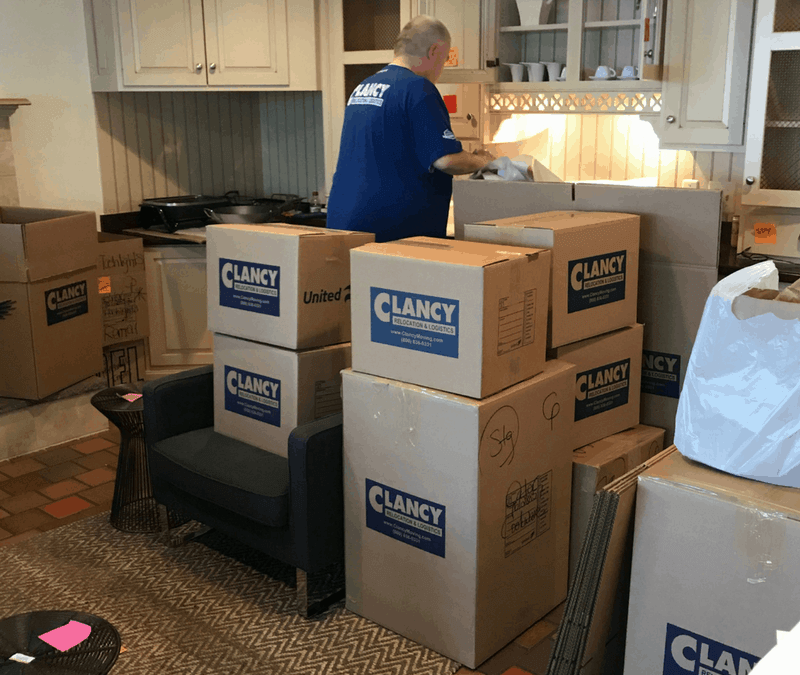
This is halfway between “mundane basic” and “something you probably don’t know.” There’s no doubt that packing on your own vs. hiring a moving company to pack for you will affect your budget. You may be easily tempted by any one of a profusion of (seemingly) inexpensive moving services that include no packing service at all in exchange for a low shipping rate.

But here’s something you may not know: if your items are packed or secured improperly, a van agent may refuse to move them. And you may not find that out until somewhere halfway to your destination when a shipment switches trucks or makes a layover at a warehouse.

For example, something that is inherently fragile, like a glass topped table, must be crated properly before it can be transported. It is easy to overlook this as a cost factor if you’re looking for a quick quote either online or over the phone.

Moving poorly packed items can become a liability for the driver, which means your attempt to save money may turn into unpleasant fees later when either your shipment is waylaid at a warehouse or waiting to be repacked before it can continue to its destination.

Even if your packaging is perfect, you may still be headed for extra costs. Professional movers are versed in space usage, which means they know how to get the most out of the space available in any given vehicle. Your untrained eye may not have the same grasp on size and space, which can leave you with oversized, undersized or just badly-sized containers that take up more space than they could have if packed professionally. The end result is more space, more cost.

The bottom line is that while self-packing can seem like a cost-savings idea, be sure you understand its potential financial pitfalls before you choose it as an option. Better to understand its impact on your budget than to be unpleasantly surprised later.

Disassembly And Reassembly

From the bookcase that you’re planning to stand up in the truck to the jungle gym, you don’t want to leave behind in the yard, your choice to disassemble – or not – can impact your budget.

If you hire your moving company to do the disassembly and subsequent reassembly on the other end then you’ll need to factor that into your budget.

You may be tempted to skip the process entirely but don’t let the labor cost fool you into thinking you’re saving money by keeping items intact. Remember how we mentioned that the space you use affects cost? Depending on the size of your item and the distance you’re traveling, you may find that the cost of the space it takes up in the truck outweighs the labor cost to disassemble it in the first place.

So whether you chose to DIY or hire a pro, you have a better chance of reducing unnecessary moving costs by disassembling large and unwieldy items as much as possible.

The Quality Of Your Experience

You know the cliché, “You get what you pay for.” As overused as it may be, it can’t be overstated. As with anything, if a cost sounds too good to be true then it probably is. And while it doesn’t mean that expensive equals better, it does mean that you do pay for ethereal things like quality of service, trustworthiness, experience and ultimately the peace of mind knowing that your cherished possessions are being handled with the care they deserve.

If price shopping is your only M.O. then you could be setting yourself up for a headache and disappointment, regardless of budget. Quality may have a higher price tag but you won’t regret the cost later if you get hit with unexpected fees, find your valued items lost or damaged, run into service snags or find yourself beating your head against a wall of poor customer service.

You can’t put a price tag on quality and it can sometimes be elusive to discern. But if you look for key signals, like quality testimonials, a good Better Business Bureau rating, certifications and licenses, community participation and attention to your personal needs, then you’ll be more likely to find a professional mover you can trust.

Transportation Of Specialty Items

One of the often unanticipated costs of moving comes into play when moving oversized, heavy, delicate or otherwise atypical items. The usual weight-plus-size calculations can go out the window in the face of a baby grand piano or slate-surfaced pool table.

Not only does weight factor into cost, but the effort and equipment required to move the item does, too. Extremely heavy items require more manpower and may present unique challenges when it comes to getting the item up and down staircases. Large items present similar problems getting through doorways. If you’re moving from a ranch home to a 10th story apartment, your moving company may need to bring cranes and pulleys to bring items in through windows that won’t make it into an elevator or hallway.

You may find yourself with additional costs to repair damage to walls and doorways as you move out of one home and into another. A good professional mover will take precautions to protect floors, walls, and doorways but the reality is that sometimes damage can’t be avoided.

If you’ve hired based on quality, you’ll know what to expect and be able to rely on quality customer service to handle whatever situation arises.

The Insured Value Of Your Items

Perhaps the most misunderstood of moving costs is insurance. While drivers carry insurance and the moving company has its own liability insurance, the cost of insuring your most valuable possessions is another matter. If you have a valuable antique, piece or artwork or heirloom, the weight and size alone may give you a transportation cost, but not a cost to insure it against loss or damage.

If you want to insure your items for their monetary value then you will need to include that in your moving budget because this insurance is not built into cost by default. Let your movers know about any special items so they can advise you on proper insurance and appropriate budget.

Where You’re Moving To – And From

Here’s a relatively unknown reality of moving: before you can move, you may need a truck to move your items… to another truck.

If you’re moving to (or from) a sprawling estate with a long and narrow driveway, or into (or out of) a tiny midtown apartment, trucks, and vans may not actually be able to get to your front door. So what happens when you need to get that 500-pound pool table down a mile-long driveway to the tractor-trailer awaiting it? The answer is simple: shuttle trucks.

Shuttle trucks are smaller trucks that can navigate narrow streets and driveways in a way that large vans and trucks cannot. And needing a shuttle truck will affect your budget. From the labor to the time it takes to make that extra hop from the front door to large trailer, you can expect to pay more for a move if you find yourself in this scenario. And unless you know enough to ask, a moving company that you’ve chosen based on price may not mention it until you’re hit with fees later.

In the end, the cost to hire a professional residential mover depends on many factors. That’s why it’s crucial to get an in-home estimate from a reputable company so that you’ll have a better understanding of what factors will impact your move. There is no “one size fits all” cost and that can make it challenging to create a budget unless someone can evaluate your items along with both the interior and exterior landscape of your old and new homes.

If you’re planning a move, let us know so we can provide you with a free estimate tailored to your specific needs. We’re available to answer all your questions and help you budget effectively, even in the face of the unknowns.

PUTNAM — FAIRFIELD — Clancy Relocation & Logistics is looking to train the right people for our summer workforce.

You will learn the ins and outs of residential and commercial moving. You will also be trained in the proper method of packing merchandise for shipping and warehousing.

The whole time you’re learning the moving industry, you will also be earning money for college and skills that you can take anywhere in the world. Many of our employees return every summer during breaks and some even return to become part of our management team and commercial drivers.

These are entry level positions.  No experience necessary.

If you think you’d like to give it a try call our office at 845-878-4080 ext. 578 or stop by 2287 Route 292, Holmes, NY.   Thank you – we look forward to hearing from you!

Additional facilities in Patterson, NY (Putnam County) and Pawling, NY (Southern Dutchess County) and in Newtown, CT (Fairfield County).

Are You an Experienced Mover or Driver?  

Please click here to see Career Opportunities at Clancy for experienced Movers, Drivers and more.

Planning to move to a new office location in the New Year?  Moving your office can be a complex undertaking especially if you are new to office relocation procedures.  The 6 key factors below that determine the cost of office moving are very similar the household move estimate process you may have been through.

At Clancy, our move consultants are experienced with helping customers of all sizes and with a wide variety of needs.   Let us help you with more than just the heavy-lifting.  We are happy to help you plan your office move starting with getting a better understanding of what goes into estimating the cost of office moving.

Know these 6 practical office moving cost factors that go into estimating the cost of office moving:

1. Types of office spaces being moved.

To prepare the most accurate office moving estimate, your Clancy representative will conduct a free visual inspection and consultation at your office.  Modular workstations (commonly referred to as cubicles) are much different than open-plan office spaces which is why estimating based on square footage is not enough.

Does your office have a kitchen?  A storage closet?  A server room?  What type of furniture do you have?  Clancy Installers are certified in many lines of commercial furniture and can provide disassembly and reassembly if reconfigurations or office restacking is part of your project.  Clancy techs can assist with disconnecting and reconnecting as well as server relocating computers, VoIP telephone systems as well as servers.  There are many types of office/commercial space that factor into the cost of moving; not all moving companies have the variety of resources and staff that Clancy does.

Clancy offers an efficient, convenient, cost-effective experience saving clients both time and money while delivering Quality and Safety.

2. Size and weight of furniture.

It is highly recommended you instruct staff to NOT try to move heavy items themselves.  Clancy’s movers are trained for Quality and Safety when moving items. Don’t risk workplace injury occurrences that can be avoided.

If your office has oversize furnishings, equipment, sculptures or valuable artwork special care may be required to move them safely.  If needed, Clancy craftsmen are ready to build a custom crate and our Professional Rigging Team can manage even the most challenging projects.

3. Amount of artwork to be removed and re-installed.

Let your staff know ahead of time to bring home any personal artwork hanging on their walls or in their cubicles and to only bring it back after the project is complete. To reduce liability, plan on our professional movers to pack and relocate all company artwork.

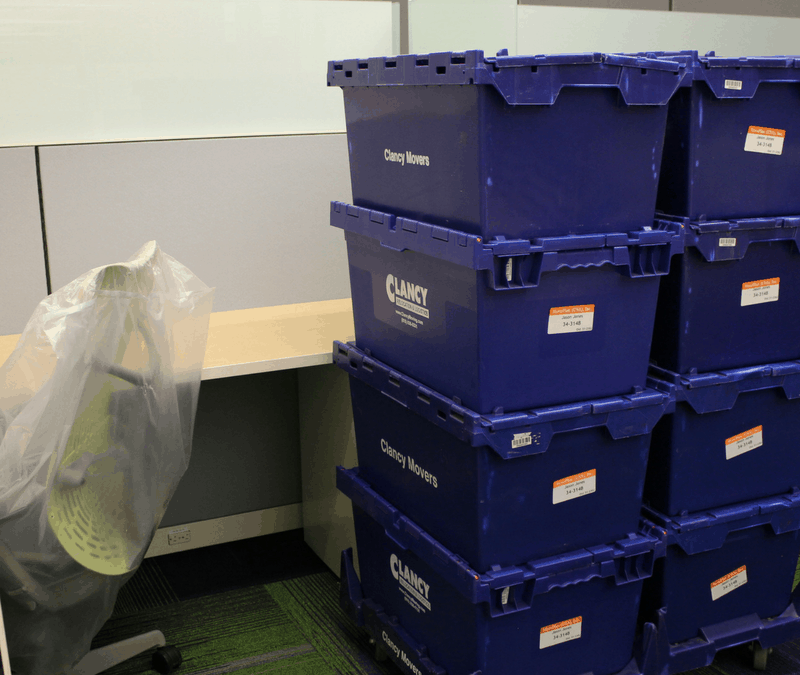
4. Plastic reusable Crate rentals and/or boxes.

It’s a good idea in the months and weeks leading up to your move that your team does a “purge campaign” to remove excess.  Purge all the things!  Remove any obsolete, duplicate or non-essential materials from your office.  By enlisting your staff and colleagues help, you can effectively reduce the costs of materials associated with moving your office.

Each employee should be responsible for packing and unpacking their own work area and personal effects.  Personal belongings and artwork should be removed prior to moving day and only brought back once the relocation is complete.

5. Distance being moved.

Relocating your office to a new floor requires labor and packing supplies.  Clancy also provides floor, wall and door/entryway protection which is required by many property managers.  It’s important to ask your building manager what the rules for moving are.   Even moving to a new floor may require professional movers with a certificate of insurance.  Be sure to also ask about elevators and if reserving a service elevator is required.  The tenant must handle arrangements with the building, generally, outside vendors are not permitted to do so.  The majority of building management companies insist that tenants make move in/out arrangements and won’t take instruction from outside vendors.

Moving your office longer distances involves trucking.  Trucks require fuel and a driver at minimum.  Only so many crew members can legally fit into a truck.  Be prepared to see some transportation expenses relative to the distance your office needs to travel.

6. Timeframe chosen for moving day.

The summer months are the busiest time of year for moving.  Most businesses choose to move on weekends and/or are required by the property manager to move after office hours.  A move during business hours may cost less than after hours.  To save money on your office move, try to plan a move during the off-season late September through April.  Steer clear of holidays too (overtime).

Now that you’ve reviewed this short list of what goes into determining the cost, we invite you to contact us today to get your office moving quote.  Our team has decades of experience for you to leverage.  We look forward to hearing from you!